Losing a tooth can affect much more than the appearance of your smile. Missing teeth may make certain foods difficult to eat, change how you speak, and leave you feeling more self-conscious in social situations. Over time, changes can also occur in the jawbone and surrounding oral structures.
If you are missing one tooth, several teeth, or most of your teeth, you may be wondering what comes next.
Two of the most familiar tooth replacement options are dental implants and dentures. Both can restore missing teeth, but they work very differently. Implants are anchored into the jawbone and can support individual teeth, bridges, or full-arch restorations. Traditional dentures are removable appliances designed to replace several or all missing teeth.
For patients comparing dental implants vs. dentures, the right choice depends on your oral health, bone availability, number of missing teeth, lifestyle, budget, and personal priorities.
Here is what patients exploring dental implants in Port Coquitlam should understand before making a decision.
What Are Dental Implants?
A dental implant replaces the root portion of a missing tooth.
The Canadian Dental Association describes a dental implant as an artificial root made from titanium that is placed into the jawbone. As healing occurs, the implant bonds with the surrounding bone and provides an anchor for the replacement tooth.
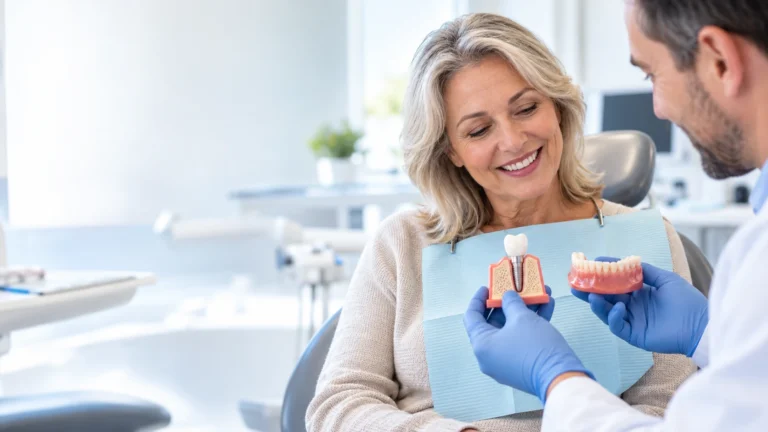
A typical single-tooth implant restoration has three main components:
- The implant: A biocompatible post placed in the jawbone to replace the missing root.
- The abutment: A connector between the implant and the visible restoration.
- The crown: The custom-made artificial tooth attached above the gumline.
Depending on the clinical situation, implants can also support bridges or full-arch restorations rather than replacing teeth individually.
New Beam Dental offers dental implants in Port Coquitlam for patients missing one tooth, multiple teeth, or a complete arch.
Why Do Patients Choose Dental Implants?
One of the biggest differences between an implant and a removable denture is stability.
Because an implant is anchored in the jawbone, the restoration does not rely on suction or denture adhesive to remain in position. This can make eating, speaking, and smiling feel more natural for many patients.
Implants also transfer chewing forces into the jawbone. This stimulation can help preserve bone in the area compared with leaving a missing tooth unreplaced.
Other potential benefits include:
- A fixed and stable feel
- Natural-looking tooth replacement
- No removable appliance for single-tooth restorations
- Strong chewing function
- No need to prepare healthy neighbouring teeth for a conventional bridge
- Ability to replace one tooth, several teeth, or support a complete arch
Implant-supported teeth still require excellent oral hygiene. The Canadian Dental Association advises patients to carefully brush and clean around implants and maintain regular dental examinations.
Who Is a Candidate for Dental Implants?
Dental implants are not automatically appropriate for every patient.
Your dentist needs to assess the health of your gums, the amount and quality of available jawbone, your medical history, medications, oral hygiene, and other factors that may affect healing.
The Canadian Dental Association notes that patients generally need healthy gums and sufficient jawbone to support an implant. If bone has been lost, bone grafting may sometimes be considered before implant placement.
At New Beam Dental, patients who do not initially have enough bone may be assessed for additional bone support or other tooth replacement options.
What Are Modern Dentures?
Dentures are removable appliances used to replace missing teeth and surrounding tissues.
Although many people associate dentures exclusively with complete tooth loss, there are different types.
Partial dentures replace several missing teeth while some natural teeth remain. They may use clasps or other components to help keep the appliance in position.
Complete dentures replace all of the teeth in the upper jaw, lower jaw, or both.
Modern dentures are custom-made to fit the patient’s mouth and can provide an effective way to restore appearance and basic chewing function without implant surgery.
Why Do Patients Choose Dentures?
For some people, dentures offer a practical and accessible solution.
Potential advantages include:
- No implant surgery
- Ability to replace many teeth at once
- Generally lower initial cost than implant treatment
- Treatment may be completed more quickly than a multi-stage implant procedure
- Options for patients who may not be candidates for implant surgery
Dentures can be especially useful when numerous teeth need to be replaced and the patient prefers a removable, non-surgical solution.
What Are the Trade-Offs?
Because conventional dentures are not anchored directly into the jawbone, they do not behave exactly like natural teeth.
A complete denture may rely on the shape of the gums, suction, muscular control, and sometimes denture adhesive for retention. Lower dentures can be particularly challenging for some patients because there is less surface area available for stability.
The mouth also continues to change after teeth are lost. The gums and underlying bone can change shape, affecting how a denture fits.
The Canadian Dental Association notes that dentures may need to be adjusted as the mouth changes. Immediate dentures can require relining during healing because the gums and bone may shrink after teeth are removed.
Dentures also need to be removed and cleaned regularly, and patients may need some time to adapt to speaking and eating with them.
Dental Implants vs. Dentures: What Are the Main Differences?
When comparing tooth replacement options in PoCo, it helps to look beyond appearance. Comfort, maintenance, chewing ability, oral health, treatment time, and budget can all influence the decision.
Longevity and Durability
Dental implants are designed as a long-term tooth replacement solution. The implant itself may remain functional for many years with good oral health and appropriate maintenance, although the crown, bridge, or prosthetic components attached to it can eventually require repair or replacement.
Dentures also require ongoing maintenance. As your mouth changes over time, they may need adjustments, relining, repairs, or eventual replacement to maintain an appropriate fit.
Rather than focusing on a guaranteed number of years, it is more helpful to consider the maintenance each option will require over your lifetime.
Chewing and Dietary Freedom
Implant-supported teeth generally provide greater stability because they are anchored into the jawbone.
For many patients, this can make it easier to chew a wider variety of foods confidently.
Traditional dentures can also restore useful chewing function, but adapting to them may take time. Some patients find particularly hard, sticky, or difficult-to-chew foods more challenging with removable dentures.
Individual results vary considerably, so it is important to discuss your diet and expectations during your consultation.
Jawbone Health and Facial Support
Bone responds to stimulation. Natural tooth roots transmit chewing forces into the jaw, helping maintain the surrounding bone.
After a tooth is lost, the bone in that area can gradually change because the natural root is no longer present.
Dental implants interact with the jawbone and provide stimulation during function. This is one reason bone preservation is an important consideration when discussing implant treatment.
Conventional removable dentures sit over the gums and do not replace the missing tooth roots. Changes to the underlying bone can therefore continue, which is one reason denture fit may change over time.
Upfront Cost vs. Long-Term Value
Cost is understandably an important consideration.
Traditional dentures generally have a lower initial cost than dental implants. For patients replacing many teeth at once, this can make dentures an accessible option.
Implant treatment typically involves a larger upfront investment because it may include surgery, imaging, implant components, healing time, and custom restorations.
However, price alone does not tell the entire story.
When comparing options, consider ongoing maintenance, potential denture adjustments and relines, future prosthetic repairs, your desired chewing function, and how each treatment fits your lifestyle.
Dental insurance coverage also varies, so it is worth reviewing your specific plan before beginning treatment.
What About Implant-Supported Dentures?
The decision does not always have to be conventional dentures or fixed individual implants.
An implant-supported overdenture combines elements of both treatments.
A small number of strategically positioned implants can be used to help retain a removable denture. Instead of relying only on the gums and suction, the denture connects to the implants for additional stability.
The Canadian Dental Association explains that overdentures can fit over remaining natural teeth or dental implants. For patients without natural teeth, implants may be placed in the jawbone so the overdenture can attach to them.
This approach can be particularly appealing to patients who want improved denture stability without replacing every missing tooth with an individual implant.
New Beam Dental also provides implant-supported options for patients missing multiple teeth or a complete arch, including implant-supported bridges and full-arch solutions.
A Detail-Focused Approach at New Beam Dental
Successful tooth replacement involves more than filling an empty space.
Your bite, tooth proportions, jaw relationships, restoration contours, and how your upper and lower teeth function together all influence comfort and appearance.
This is an area where Dr. Akshay brings an interesting perspective to patient care.
Before becoming a licensed dentist, Dr. Akshay worked as a dental technician, a background New Beam Dental says contributes to his detail-focused approach to dentistry. That experience can provide useful technical insight when considering the restorative side of treatment, where precision, fit, bite relationships, and aesthetics all matter.
New Beam Dental combines this attention to detail with a patient-focused philosophy built around education and clear communication. The team takes time to understand each patient’s goals, explain treatment options, and provide personalized care.
The clinic welcomes children, adults, seniors, and families from Port Coquitlam, Coquitlam, Port Moody, and surrounding Tri-Cities communities.
How Do You Know Which Tooth Replacement Is Right for You?
There is no single treatment that is best for every person.
Dental implants may appeal to someone who prioritizes stability, chewing function, and a fixed restoration and who has the oral and general health required for implant treatment.
Traditional dentures may be a better fit for someone who wants to avoid surgery, needs to replace many teeth, or is looking for a solution with a lower initial investment.
An implant-supported denture may provide a middle ground for someone who wants greater stability while still using a removable full-arch restoration.
The decision should be based on a clinical examination rather than assumptions about age alone.
Your dentist may assess:
- How many teeth are missing
- The health of remaining teeth and gums
- Available jawbone
- Your bite and chewing patterns
- Your medical history
- Your comfort with surgery
- Your aesthetic expectations
- Your budget and insurance coverage
- Your preferences for fixed versus removable teeth
Replace Missing Teeth With a Plan Designed for You
Missing teeth can affect eating, speaking, appearance, and everyday confidence, but there are more tooth replacement possibilities today than simply accepting the gaps or assuming traditional dentures are your only option.
Whether you are considering dental implants, traditional dentures, or an implant-supported restoration, the right starting point is a personalized examination.
New Beam Dental can evaluate your teeth, gums, jawbone, bite, health history, and treatment goals before explaining which options may be appropriate for you.
If you are looking to replace missing teeth in Port Coquitlam, book a tooth replacement consultation with New Beam Dental Clinic. The team welcomes patients from Port Coquitlam and throughout the Tri-Cities and offers convenient online appointment booking.
Take the first step toward a smile that feels comfortable, functional, and natural by scheduling your consultation with New Beam Dental today.